ND Experts on PFAS Research
Per- and polyfluoroalkyl substances (PFAS) are widely used in industrial and commercial applications ranging from nonstick cookware to firefighting foams. PFAS have been linked to several adverse health conditions including immunosuppression, hormonal dysregulation, developmental delays in children, low birth weight and accelerated puberty, high blood pressure in pregnant women, and an increased risk of some cancers.
The University of Notre Dame is tackling these "forever chemicals," identifying environmental impacts, developing new ways to measure and manage contaminated water supplies, and exploring new methods for clean-up.

Fighting to Protect the Brave
Research from Notre Dame's Graham Peaslee has found that firefighters are at risk before they ever leave the firehouse. Using a spectroscopic technique and the St. Andre particle accelerator, He has found alarming amounts of polyfluoroalkyl substances (PFAS) in firefighter gear. Peaslee’s work in this area has encouraged several companies to reduce or eliminate PFAS, and the EPA and state legislators have also made policy changes.
PFAS in Products

Researchers detect elevated levels of PFAS in some fitness tracker and smartwatch bands
Fitness trackers and smartwatch bands are the latest consumer products found to contain per- and polyfluoroalkyl substances (PFAS), according to research from Notre Dame.

Use of PFAS in cosmetics widespread, new study finds
Many cosmetics sold in the United States and Canada likely contain high levels of PFAS, a potentially toxic class of chemicals linked to several serious health conditions, according to research led by Notre Dame's Graham Peaslee.

New study finds extensive use of fluorinated chemicals in fast food wrappers
Researchers tested more than 400 samples of packaging materials, including hamburger and sandwich wrappers, pastry bags, beverage cups and French fry containers, and found evidence of PFAS.

Study finds high levels of PFAS in school uniforms
Researchers have found notably high levels of PFAS in school uniforms sold in North America. In a study published in Environmental Science and Technology, scientists analyzed a variety of children’s textiles. Concentrations were highest in school uniforms — and higher in those labeled as 100 percent cotton as opposed to synthetics.
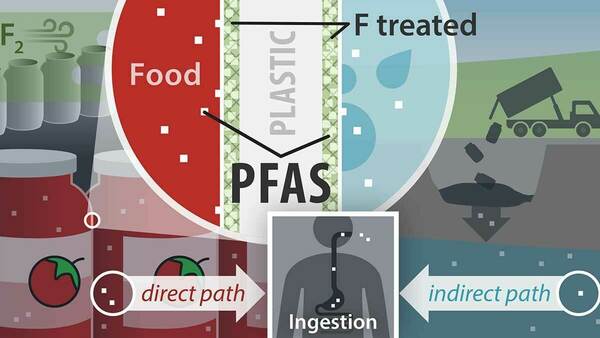
Plastic containers can contain PFAS — and it’s getting into food
Researchers at Notre Dame are adding to their list of consumer products that contain "forever chemicals.” The study found that some plastic containers — used for household cleaners, pesticides, personal care products and, potentially, food packaging — tested positive for PFAS.

Scientists find PFAS in feminine hygiene products
Researchers tested more than 100 samples, consisting of both packaging and individual products, for fluorinated compounds including menstrual underwear, disposable and reusable pads, tampons, menstrual cups, panty liners and disposable and reusable incontinence underwear.
Experts in the News

Removing PFAS from public water systems will cost billions and take time – here are ways you can filter out harmful ‘forever chemicals’ at home
Authored by Kyle Doudrick

We Had 44 Period and Incontinence Products Tested for Forever Chemicals. Many Were Contaminated.
In early 2023, we bought and mailed 44 different products to Graham Peaslee, whose University of Notre Dame lab studies PFAS in the environment and has performed tens of thousands of tests looking for signs of contamination with these substances in consumer products.

Why getting PFAS out of our products is so hard — and why it matters
“This stuff is toxic at incredibly low levels and it’s persistent — it stays there for hundreds of years in the groundwater, thousands of years,” said Graham Peaslee, a Notre Dame professor and researcher who’s tested many products for PFAS in his lab. “And that means the next generations will be drinking it, and that’s not the kind of legacy we want to leave our kids.”